When parents drop their child off at preschool in the morning, most picture letters on a board, counting exercises, and maybe some finger painting. And yes, those things happen. But a great preschool day is doing something far more profound than teaching the alphabet. Every transition, every group activity, every moment of free play is quietly building skills that will shape your child for years to come. Understanding what is really happening inside those walls can change the way you see early childhood education entirely.
The Hidden Curriculum of a Great Preschool Day
There is a concept in early education called the hidden curriculum. It refers to all the learning that happens outside of formal lessons. In a quality preschool, this hidden curriculum is arguably more important than anything on the official schedule. Children are learning how to regulate their emotions when they do not get the toy they wanted. They are learning patience, turn-taking, and how to express themselves clearly to someone other than a parent. According to the Center on the Social and Emotional Foundations for Early Learning, these social-emotional skills are among the strongest predictors of a child’s success in school and in life. The daily rhythm of a well-run preschool is designed, often invisibly, to build them.
Morning Arrival: More Than Just Saying Hello
The way a preschool morning begins sets the tone for everything that follows. Children learn to separate from their caregivers, hang up their bags, and transition into the classroom routine independently. These may seem like small acts, but they are building real emotional and executive function skills. Saying goodbye without falling apart requires emotional regulation. Finding your peg and putting your things away requires memory and self-organisation. For children attending The Step by Step School near Hudson Street in Hoboken, the consistency of a warm, welcoming morning routine means children arrive ready to engage rather than anxious and unsettled. Predictable beginnings build confidence, and confidence opens the door to learning.
Circle Time: Language, Listening, and Community
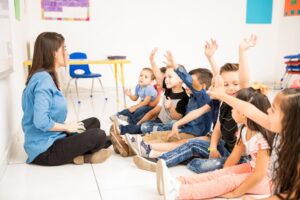
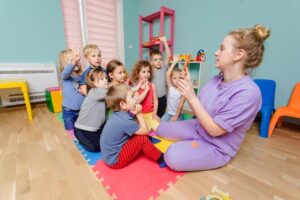
Circle time is a staple of the preschool day, and for good reason. It is where children practise one of the most important early literacy skills they will ever develop: listening with intention. When a teacher reads aloud, asks questions, and invites responses, children are building vocabulary, narrative comprehension, and the ability to organise their thoughts into words. They are also learning how to be part of a group, to wait for their turn to speak, and to respect the contributions of others. The American Speech-Language-Hearing Association highlights that oral language development in the preschool years is a critical foundation for later reading and writing success. Circle time is not just a nice routine. It is foundational literacy work in disguise.
Play-Based Learning: Where the Real Magic Happens
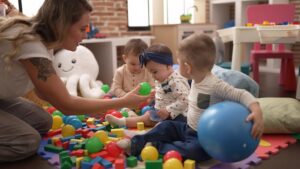
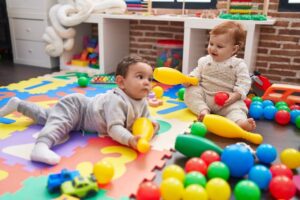
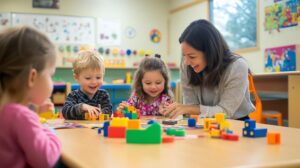
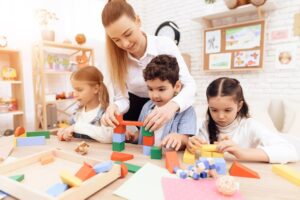
Ask any early childhood expert and they will tell you the same thing: play is the work of childhood. In a quality preschool, free play and structured play activities are not gaps between lessons. They are the lessons. When two children negotiate who gets to be the doctor in the pretend clinic, they are developing conflict resolution skills. When a child builds a tower and watches it fall, they are learning about physics, persistence, and problem-solving. The National Association for the Education of Young Children is clear on this point: play-based learning in the early years is deeply connected to cognitive development, creativity, and long-term academic performance. At The Step by Step School, play is not a break from the curriculum. It is central to it.
Art, Music, and Movement: Building the Whole Child
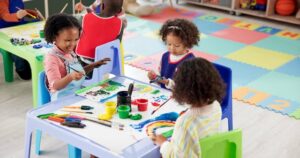
Creative activities are often the first to be underestimated by parents who are focused on academic readiness. But painting, singing, dancing, and making things with their hands are developing capacities that sit at the core of a child’s cognitive and emotional growth. Fine motor skills developed through drawing and cutting with scissors translate directly into writing readiness. Music and rhythm support mathematical thinking and phonological awareness. Movement activities build coordination, spatial awareness, and the ability to follow sequential instructions. The Harvard Center on the Developing Child notes that creative and expressive activities in early childhood support the development of neural connections that underpin learning across every subject. A preschool that invests in the arts is investing in the whole child.
Snack Time and Lunch: Life Skills in Disguise
It might seem like a break from learning, but mealtimes in a preschool setting are rich with developmental opportunity. Children practise pouring their own drinks, opening their lunch boxes, and tidying up after themselves. They learn to sit together, share space considerately, and have conversations with peers and teachers. These moments build independence, social awareness, and the kind of practical life skills that parents often wish children had more of. Families near the Monroe Street location of The Step by Step School in Hoboken often share how surprised they are by the independence their children develop, seemingly overnight, after starting preschool. Small daily habits add up to something significant over time.
Outdoor Play: Learning Without Walls
Outdoor time is not a reward for good behaviour. It is a core part of a quality preschool day, with its own developmental purpose. Physical play develops gross motor skills, balance, and coordination. It also gives children a critical opportunity to take managed risks, something that builds resilience, courage, and spatial reasoning. Outdoor environments with varied terrain, natural materials, and open space invite imaginative play that structured indoor settings simply cannot replicate. Research from the American Academy of Pediatrics shows that regular outdoor play in early childhood supports everything from attention span to immune function. A preschool that prioritises outdoor learning is prioritising your child’s health and development in equal measure.
End of Day: Reflection and Emotional Processing
The close of a preschool day is as important as its beginning. Good early childhood programmes build in time for children to reflect on their day, gather their things, and transition calmly back to their caregivers. This quiet act of closing the loop helps children begin to develop self-awareness and the ability to articulate their experiences. When a child can tell you what they did today, who they played with, and how something made them feel, they are demonstrating language development, memory consolidation, and emotional literacy all at once. These are the conversations that happen at pickup outside both the Hudson Street and Monroe Street locations in Hoboken, and they are worth paying close attention to.
What a Preschool Day Is Really Building
When you step back and look at the full arc of a preschool day, what you see is not just a schedule of activities. You see a carefully designed environment where every moment is an opportunity for growth. Children are learning to be curious, to be kind, to be resilient, and to be capable. They are building the foundations of literacy, numeracy, creativity, and social intelligence simultaneously. None of this happens by accident. It happens because passionate, skilled educators understand what children need at this stage and create the conditions for it to flourish. That is what a truly excellent preschool is doing, every single day, even when it just looks like play.
Come and See It for Yourself
The best way to understand what a preschool day really looks like is to experience it in person. Words on a page can only go so far. At The Step by Step School, we welcome families to visit our Hudson Street and Monroe Street locations in Hoboken and see first-hand how our educators create a warm, stimulating, and deeply nurturing learning environment for every child in our care. Your child is uniquely great, and we would love the opportunity to help that greatness shine. Schedule your tour today and take the first step toward a preschool experience your child will love. Contact our team here and let us answer any questions you have along the way.
Frequently Asked Questions
What does a typical preschool day look like?
A typical preschool day is structured around a consistent routine that balances active and quiet activities, group learning and independent play, indoor and outdoor time. Most days begin with a morning arrival and settling-in period, followed by circle time, structured learning activities, creative play, snack or mealtimes, outdoor play, and a calm close to the day. Within that rhythm, children are engaging in language-rich activities, social interactions, creative expression, and physical movement. The best preschool programmes make every transition and routine part of the learning experience, so development is happening continuously rather than only during designated lesson times.
How does preschool support social development?
Preschool is one of the most powerful environments for social development that a young child can experience. Being part of a consistent peer group teaches children how to share, take turns, resolve conflicts, and build friendships. Teachers in a quality preschool actively model and reinforce prosocial behaviours throughout the day, not just during dedicated circle or group times. Children learn to read social cues, express their feelings in words, and consider the perspectives of others. These skills do not develop in isolation; they need the context of real relationships, real disagreements, and real moments of connection. Preschool provides all of that in a safe, supported environment.
Is play really as important as structured learning in preschool?
Yes, absolutely. Play is not the opposite of learning in early childhood; it is one of the most effective vehicles for it. Through play, children develop problem-solving skills, creativity, language, emotional regulation, and an understanding of cause and effect. The research is consistent and clear on this point, from NAEYC to Harvard’s Center on the Developing Child. A quality preschool programme uses play intentionally, designing activities and environments that invite children to explore, create, and collaborate. Structured lessons have their place, but a preschool that sidelines play in favour of rote academic exercises is actually working against optimal child development.
How do preschool teachers support learning throughout the day?
Great preschool teachers are doing far more than supervising. They are observing each child closely, identifying where they are developmentally, and gently scaffolding their growth through carefully chosen activities, questions, and interactions. They narrate what children are doing to build vocabulary, ask open-ended questions to develop thinking, and model the social and emotional behaviours they want children to internalise. They also create the physical environment of the classroom with intention, arranging materials and spaces to invite exploration and discovery. At The Step by Step School, educators bring genuine passion and skill to this work every day, ensuring that every child in their care is seen, known, and actively supported.
What should I look for in a preschool in Hoboken?
When evaluating a preschool in Hoboken, look for a programme with qualified and caring staff, a clearly articulated learning philosophy, and an environment that balances structure with freedom. Ask how the school supports social-emotional development alongside early literacy and numeracy. Observe how teachers speak to children and how children interact with one another. Low staff turnover and strong parent communication are both indicators of a healthy, well-run programme. The Step by Step School operates two locations in Hoboken, one on Hudson Street and one on Monroe Street, offering preschool programmes designed to nurture every child’s unique development. You can learn more about the programmes here or book a visit to see the school in person.