
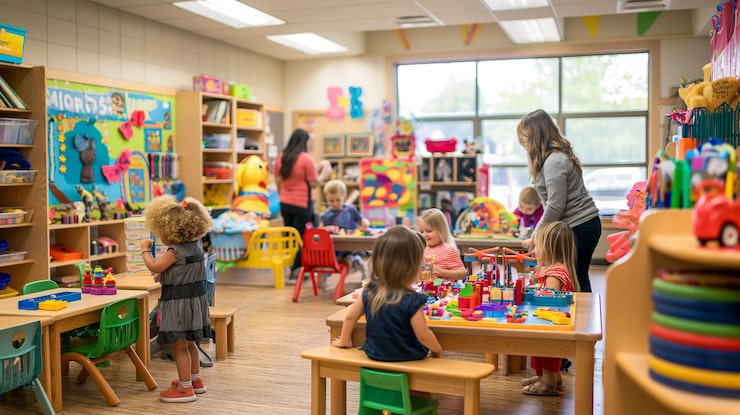
The years before kindergarten shape far more than a child’s vocabulary or motor skills. They lay the groundwork for how a child manages emotions, builds relationships, and handles conflict for years to come. Quality daycare plays a real role in this process, offering structured opportunities for children to practice these skills every single day. This guide explains how early childhood care supports social-emotional development and what to look for in a program that truly nurtures it.
What Is Social-Emotional Development?
Social-emotional development refers to a child’s growing ability to understand and manage emotions, form relationships, and make responsible decisions. The Collaborative for Academic, Social, and Emotional Learning (CASEL), a leading research organization in this field, identifies five core competencies that children build over time: self-awareness, self-management, social awareness, relationship skills, and responsible decision-making. These skills do not develop automatically. They grow through consistent practice, guidance, and daily interaction with caring adults and peers.
Early childhood is considered a critical window for building this foundation. Researchers have found that skills like emotion regulation and empathy formed in the preschool years tend to predict stronger academic and social outcomes later in life. This is one reason a thoughtful daycare hoboken NJ families choose can have such a lasting impact, well beyond the toddler years.
How Daily Daycare Routines Build These Skills
A well-run daycare naturally creates dozens of small opportunities for social-emotional growth throughout the day. Group activities like circle time, shared snacks, and collaborative play all require children to practice patience, communication, and cooperation. These moments may look simple on the surface, but they are doing real developmental work. Children learn to wait their turn, express what they need, and notice how their actions affect the people around them.
Consistent routines also play a major role. Predictable schedules help children feel secure, which in turn makes it easier for them to take emotional risks, like trying a new activity or approaching a new friend. A quality daycare hoboken NJ parents trust should intentionally build these moments into the day, not leave them to chance. Ask your daycare how they structure group activities to encourage this kind of growth.
The Role of Teachers in Emotional Growth
Teachers are often the most important factor in how well a child develops social-emotional skills at daycare. Research shows that when teachers model calm emotion coaching, such as naming feelings and guiding children through conflict, children develop stronger self-regulation skills over time. This is sometimes called co-regulation, where an adult helps a child manage big emotions until the child can manage them independently.
Look for caregivers who get down to a child’s level, validate feelings before offering solutions, and use consistent, gentle language during conflicts. A daycare hoboken NJ families recommend to one another usually has staff trained specifically in these techniques, not just general supervision skills. Ask during a tour how teachers are trained to handle tantrums, sharing conflicts, or a child struggling to separate from a parent.
Peer Interaction and Friendship Building
One advantage daycare offers that is hard to replicate elsewhere is daily, repeated interaction with the same group of peers. Children who see the same classmates day after day start to build real friendships, not just occasional playdates. They learn who shares easily, who needs extra patience, and how to resolve small disagreements without an adult stepping in every time. These experiences build empathy and cooperation skills that carry into elementary school and beyond.
Group settings also expose children to a wider range of personalities and emotional styles than they might encounter at home. This variety helps children practice flexibility and perspective-taking, both important pieces of social-emotional development. When you are comparing daycares Hoboken NJ has to offer, ask how classrooms are grouped and how teachers encourage positive peer relationships throughout the day.
What to Look for in a Daycare Hoboken NJ Parents Can Trust
Not every daycare approaches social-emotional development the same way. When touring a program, ask how the curriculum specifically supports emotional skills, not just academic milestones. A strong daycare hoboken NJ families choose should be able to describe concrete strategies, like using feelings charts, guided group discussions, or calm-down corners for children who need a moment to regulate.
At Step by Step Hoboken, our multi-theory curriculum intentionally weaves social-emotional learning into daily activities, alongside academic growth. Our teachers are trained to support children through conflicts, big feelings, and new social situations with patience and consistency. You can learn more about our approach on our programs page before scheduling a visit.
Why Families Near Hudson and Monroe Choose Step by Step Daycare Hoboken
Families throughout Hoboken choose step by step daycare hoboken because we treat social-emotional growth as a core part of early education, not an afterthought. Parents near our Hudson Street location often see this reflected in how confidently their children handle daily transitions, while families closer to our Monroe Street location value the same consistent, emotionally supportive approach in every classroom. No matter which hoboken daycare location fits your family, our teachers are focused on helping every child build real, lasting emotional skills.
At step by step Hoboken, we believe strong social-emotional foundations set children up for success far beyond the classroom. That commitment shapes everything from our daily schedule to how our teachers respond to a hard morning drop-off.
Supporting Development at Home Too
Daycare plays an important role, but what happens at home matters just as much. Research consistently shows that parenting quality and home environment have a significant influence on a child’s social-emotional development, often as much or more than any single childcare setting. Simple habits, like naming your child’s feelings out loud or talking through conflicts calmly, reinforce the same skills your child is practicing at daycare. Partnering with your child’s teachers and asking what they are working on in the classroom can help you extend that learning at home.
Give Your Child a Strong Emotional Foundation
Social-emotional development is not a bonus skill. It is a core part of how children learn to navigate school, friendships, and everyday challenges throughout their lives. A thoughtful daycare program can play a meaningful role in building these skills through daily routines, trained teachers, and consistent peer interaction. If you are looking for a daycare Hoboken NJ families trust to support your child’s emotional growth alongside their academic development, we would love to meet you. Schedule a tour at our Hudson or Monroe location, or contact us to learn more about our approach.
Frequently Asked Questions
1. What is social-emotional development in early childhood?
Social-emotional development refers to a child’s growing ability to understand emotions, build relationships, and make thoughtful decisions. It includes skills like self-awareness, empathy, and self-regulation, all of which develop gradually through daily interactions with caregivers and peers, including those found in a quality daycare setting.
2. How does daycare support social-emotional growth?
Daycare offers daily, structured opportunities for children to practice sharing, patience, and communication with peers. Group activities like circle time and collaborative play help children build empathy and cooperation skills. A well-trained daycare team also models healthy emotional responses, helping children learn to manage big feelings over time.
3. Can daycare replace the emotional support children get at home?
No, daycare complements rather than replaces the emotional support children receive at home. Research shows that parenting quality and home environment strongly influence a child’s social-emotional development. The most effective approach combines a supportive daycare setting with consistent emotional guidance from parents at home.
4. What should I ask about social-emotional learning when touring a daycare?
Ask how teachers are trained to handle conflicts, tantrums, and separation anxiety. Find out whether the daycare uses specific tools, like feelings charts or calm-down spaces, to support emotional regulation. A strong daycare program should be able to describe clear, intentional strategies rather than general statements about “caring for the whole child.”
5. At what age does social-emotional development matter most in daycare?
Social-emotional development is important at every age, but the early years, roughly ages one through five, are considered a critical window for building foundational skills. Children who practice emotion regulation and relationship skills during this stage in a quality daycare setting often carry those strengths into kindergarten and beyond.