You are a wonderful parent. You read to your child, play with them, and pour love into every single day. But there is one thing you simply cannot replicate at home, no matter how hard you try. You cannot give your child a room full of peers. You cannot manufacture the daily, unscripted, sometimes messy experience of navigating life alongside other children of the same age. That experience is what a quality daycare provides, and the social skills it builds are genuinely irreplaceable.
This is not a criticism of home life. It is an honest look at what group early childhood settings offer that nothing else can. Here is what your child actually learns socially at daycare, and why it matters far more than most parents realize.
Sharing and Turn-Taking: The Daycare Classroom as a Social Laboratory
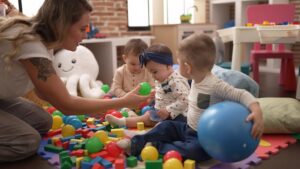
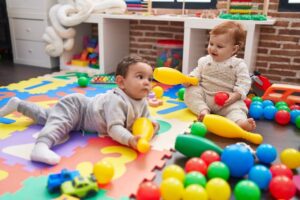
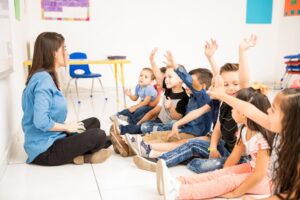
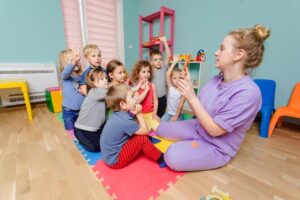
At home, your child is the center of the universe. That is not a bad thing. It is developmentally appropriate and reflects the love you give them. But it also means that every toy, every snack, and every adult’s attention belongs to them by default. In a daycare setting, that changes immediately. There are other children who want the same red truck. There is only one spot at the water table. There is one teacher managing a circle of eager little hands all raised at once.
This is where genuine sharing and turn-taking skills are born. Not because a parent told a child to share, but because the situation demands it, repeatedly, every single day. According to Zero to Three, children under three are naturally egocentric and need consistent, real-world practice in group settings to begin developing the impulse control required for genuine sharing. A quality daycare provides that practice in a safe, supervised environment where mistakes are learning moments rather than failures.
At The Step by Step School on Hudson Street in Hoboken, children practice these skills naturally throughout the daily schedule, from circle time to snack to outdoor play. The structure is intentional. The growth is real.
Conflict Resolution: Learning to Work It Out
Arguments happen. In any group of young children, conflict is not an occasional disruption. It is a daily event. And that is actually a good thing. Conflict is one of the richest learning opportunities in early childhood, provided there are skilled adults present to guide children through it rather than simply shutting it down.
In a quality daycare program, teachers do not just separate fighting children and move on. They walk children through the process of expressing their feelings, listening to the other person, and finding a solution together. This guided conflict resolution, practiced repeatedly over months and years, builds skills that carry children through every stage of life. The Collaborative for Academic, Social, and Emotional Learning identifies conflict resolution as a core social-emotional competency that predicts positive outcomes in academic performance, relationships, and mental health well into adulthood.
You can model conflict resolution at home. But your child can only truly practice it with peers. Daycare provides those peers every single day.
Reading Social Cues: The Skill Nobody Talks About Enough
One of the most important social skills a child develops in early childhood is the ability to read other people. Facial expressions, body language, tone of voice; these are signals that tell your child whether someone is open to playing, upset, or needs space. This skill is called social cognition, and it develops through constant, varied interaction with other children.
At home, your child primarily reads the cues of the adults they live with. Those adults love them unconditionally and tend to be highly readable and accommodating. Peers are different. A three-year-old who does not want to play does not soften the message. A child who is upset shows it directly. Navigating those unfiltered social signals is genuinely challenging and genuinely formative. A daycare classroom is one of the best environments in the world for developing this skill because the social landscape is rich, varied, and constantly changing.
Research from the Harvard Center on the Developing Child confirms that early peer interaction builds the neural pathways associated with empathy, perspective-taking, and social awareness. These are not skills that develop in isolation. They require other people, specifically other children, to fully emerge.
Cooperation and Teamwork: Getting Things Done Together
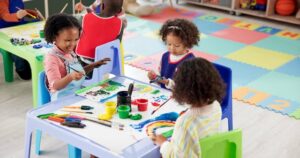
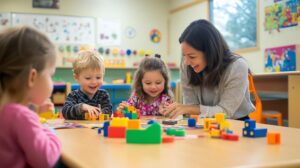
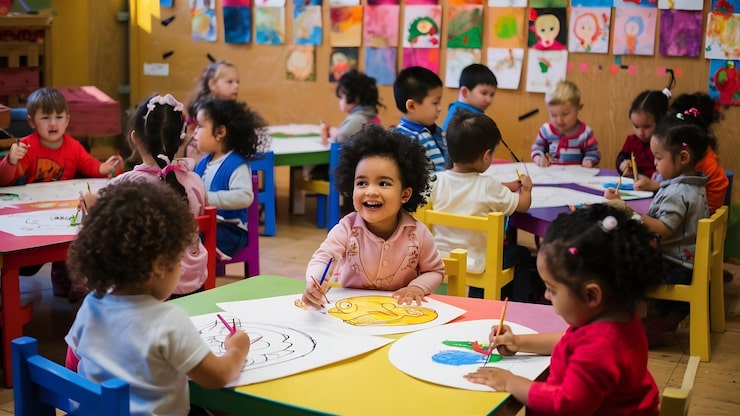
Building a block tower alone is satisfying. Building one with three other children who all have different ideas about how it should look is an entirely different challenge. Cooperation requires children to communicate their ideas, listen to others, compromise, and work toward a shared goal. These are the exact skills that employers list as most valuable in adults, and they begin developing in the daycare classroom.
Group projects, collaborative play, and shared activities are built into the fabric of a quality early childhood program. At the Monroe Street location of The Step by Step School in Hoboken, children engage in group activities designed specifically to build cooperative skills alongside cognitive and creative development. The goal is never just the finished project. It is always the process of getting there together.
Friendship: How Children Learn to Choose and Keep One
Making a friend sounds simple. For a young child, it is one of the most complex social tasks they will ever attempt. It requires initiating contact, sustaining interaction, managing disappointment when things go wrong, and repairing the relationship afterward. Children who attend daycare get to practice all of these steps repeatedly with a consistent group of peers over months and years.
These early friendships matter deeply. According to the American Academy of Pediatrics, positive peer relationships in early childhood are strongly associated with better social adjustment in kindergarten, greater academic engagement, and lower rates of anxiety and behavioral difficulty in later childhood. The friendships your child forms at daycare are not just cute. They are doing important developmental work.
Families near Hudson Street and Monroe Street in Hoboken who enroll their children at The Step by Step School often remark on how quickly their children form genuine bonds with classmates. That is not accidental. It is the result of a program that gives children consistent time, space, and support to build real friendships.
Independence and Self-Advocacy: Speaking Up for Yourself
At home, you often know what your child needs before they ask. You anticipate hunger, tiredness, and frustration because you know your child intimately. In a daycare setting, children must learn to ask for what they need. They must tell a teacher they are hungry, or that another child took their toy, or that they do not feel well. This self-advocacy is a foundational life skill.
Children who practice asking for help, expressing preferences, and asserting their needs in a respectful way develop a confidence and independence that follows them into school and beyond. A great daycare creates the conditions for this by being responsive enough that children feel safe asking, but not so anticipatory that children never need to.
Give Your Child the Social Foundation They Deserve
The social skills built in a quality daycare setting are not supplemental. They are foundational. Sharing, conflict resolution, empathy, cooperation, friendship, and self-advocacy are the skills that shape how your child moves through the world for the rest of their life. You can support these skills at home. But the peer environment that truly develops them exists in a program built specifically for that purpose.
Schedule a tour at The Step by Step School on Hudson Street or Monroe Street in Hoboken and see firsthand how we build these skills every single day. Or contact us to learn more about our programs for children from six weeks to thirteen years old. Your child’s social future starts now. We would love to be part of it.
Frequently Asked Questions
1. What social skills does daycare help children develop?
Daycare helps children develop a wide range of social skills that require peer interaction to fully form. These include sharing, turn-taking, conflict resolution, empathy, cooperation, friendship building, and self-advocacy. Children also develop the ability to read social cues, manage frustration in group settings, and communicate their needs to adults who are not their primary caregivers. These skills emerge naturally through daily interaction with peers in a structured, supportive environment that a home setting simply cannot replicate on its own.
2. At what age do children begin to develop social skills at daycare?
Social development begins from birth. Even very young infants respond to faces, voices, and emotional cues from the people around them. By six to twelve months, babies show clear preferences for familiar people and begin to engage in simple back-and-forth interactions. Toddlers from eighteen months onward begin parallel play, which gradually evolves into cooperative play by age three or four. Quality daycare programs support each stage of this progression with age-appropriate activities and skilled caregivers who know how to nurture social growth at every level.
3. Can children develop strong social skills without attending daycare?
Children can develop social skills through playgroups, family interactions, and community activities. However, the consistent, daily peer interaction that a daycare setting provides is difficult to replicate through occasional social experiences alone. The regularity of group life at daycare, the guided conflict resolution, the structured cooperative activities, and the sustained friendships all create a depth of social practice that significantly accelerates development. Research consistently shows that children who attend quality early childhood programs demonstrate stronger social competence when they enter kindergarten.
4. How do daycare teachers actively support social skill development?
Quality daycare teachers support social development in both planned and spontaneous ways throughout the day. They model positive social behavior, narrate social situations to help children understand what is happening, guide children through conflict using age-appropriate language, facilitate cooperative activities, and praise prosocial behavior specifically and genuinely. They also observe children’s social patterns and share insights with parents so that families can reinforce the same skills at home. The best teachers see social development as just as important as any academic milestone.
5. How do I know if my child is developing social skills at their daycare?
Talk to your child’s teachers regularly and ask specifically about social interactions, not just behavior or academic progress. Signs that your child is developing well socially include forming named friendships with classmates, resolving small conflicts with less adult intervention over time, showing empathy toward other children, and expressing their needs and preferences more clearly. You may also notice growing confidence, increased independence, and greater flexibility at home as social skills developed at daycare carry over into family life. If you have concerns, raise them early; a good daycare team will welcome the conversation.